The Best Waterfront Neighborhoods for Homebuyers in 2026
16 September 2026
Waterfront living has a pull that few other property types can match. The light on the water at dusk, the sound of rain hitting a dock, the ability to step out your back door and be on the water in minutes. But the gap between the fantasy and the reality of owning waterfront property is wider than most buyers expect, and in 2026 that gap is shaped by forces that did not exist a decade ago: climate risk disclosure, insurance repricing, remote work migration patterns, and a shrinking supply of buildable shoreline.
This guide is not a list of pretty postcodes. It is a working framework for choosing a waterfront neighborhood, built around the trade-offs that actually determine whether you will be happy in five years and solvent in fifteen. I will name specific regions and explain what makes each one function, who it suits, and where the risks sit. I will also cover the questions most buyers only think to ask after closing, when the answers are expensive.
Why 2026 Is a Different Waterfront Market
Three shifts matter more than anything else right now.First, insurance. In several coastal and riverfront markets, flood and wind premiums have moved from a rounding error to a line item that can rival a mortgage payment. Buyers who budgeted for the house but not the policy have been blindsided. In some cases, carriers have withdrawn entirely from certain zip codes, pushing homeowners into state-backed residual insurers that cost more and cover less.
Second, climate data is now public and granular. Flood factor scores, sea-level projections, and storm surge models are embedded in listing platforms and lender underwriting. This cuts both ways. It protects you from a bad purchase, but it also means that a property with a poor score may be difficult to sell later, even if it has never flooded.
Third, scarcity. Genuinely buildable waterfront lots, meaning lots with road access, utilities, and permits, are close to exhausted in desirable metros. What remains is often redevelopment rather than new construction. That scarcity supports long-term value in resilient locations and punishes fragile ones.
Understanding these three forces lets you read any waterfront market with a clearer eye. The rest of this article applies them.
How to Judge a Waterfront Neighborhood Before You Fall in Love
Before naming places, here is the filter I would use. Apply it to every neighborhood you consider.Water type and what it means day to day
Oceanfront, bayfront, lakefront, riverfront, and canal-front are not variations on a theme. They behave differently.- Oceanfront offers the most dramatic experience and the highest risk. Wave action, salt, wind, and erosion are constant. Maintenance costs run high.
- Bay and sound frontage usually delivers calmer water, better swimming, and more protection from direct wave energy, though storm surge can still be severe.
- Lakefront tends to be the most stable category. No tides, no salt, generally lower insurance, and a defined shoreline. The trade-off is that desirable lakes are often seasonal markets with quieter winters.
- Riverfront is underrated. Moving water, mature tree canopy, and lower price points per foot. The catch is floodplain regulation, which varies enormously by jurisdiction.
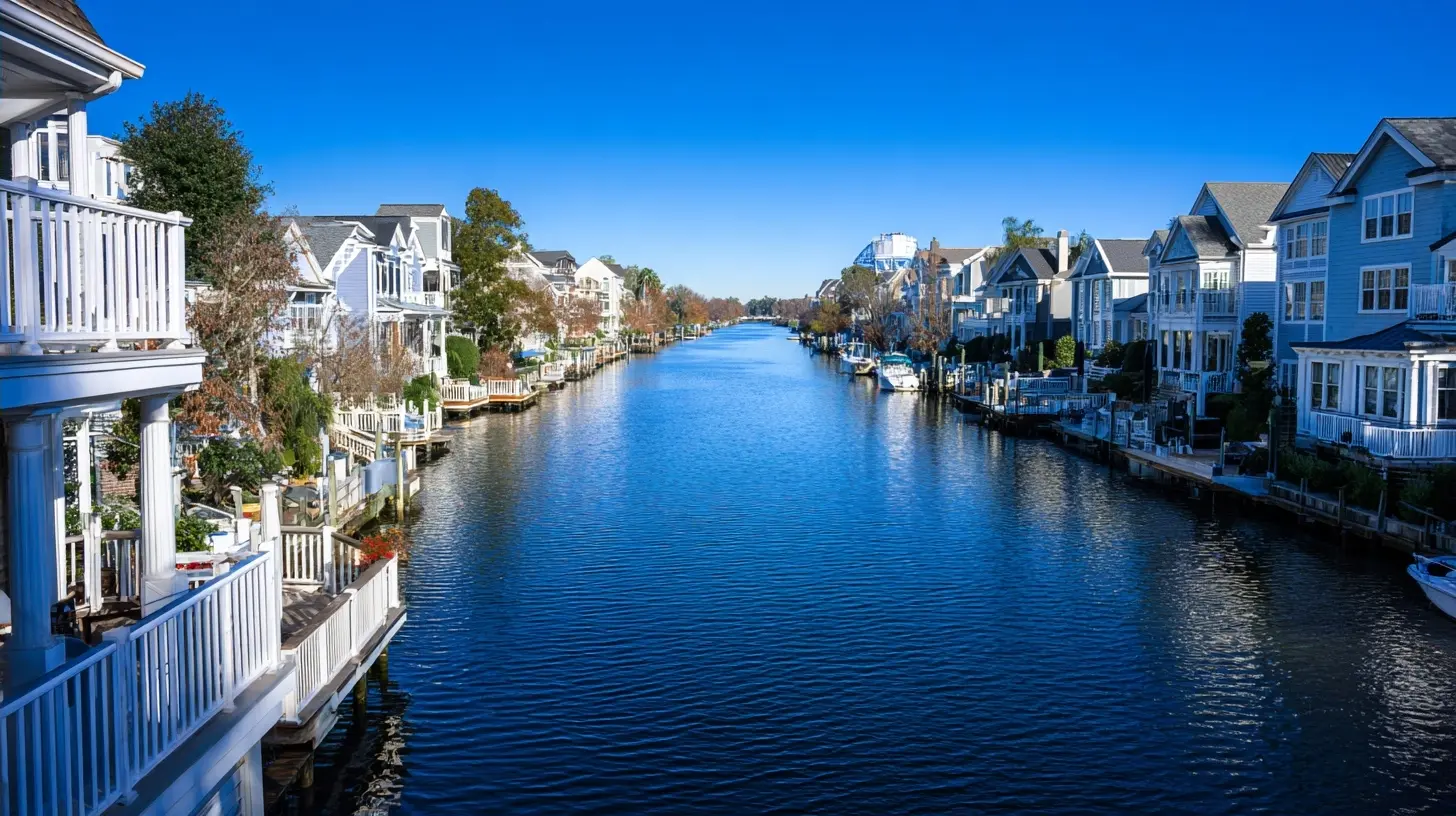
- Canal-front is a lifestyle purchase. You are buying boat access, not a view. Check channel depth, bridge clearance, and whether the canal is maintained by a district or by you.
The four numbers that decide everything
Ask for these before you make an offer, not after.1. Flood zone designation and the elevation certificate. The certificate tells you the actual base flood elevation of the structure, not the neighborhood average.
2. Insurance quotes, plural. Get three, from different carriers, for the specific address. Do not accept the seller's current premium as representative.
3. Shoreline ownership. In many states, the land below the high water mark is public, and your "private beach" is legally a easement. Confirm what you actually own.
4. Armor and maintenance obligations. Seawalls, revetments, and dock pilings have service lives. Replacing a failing seawall can cost as much as a kitchen renovation, and in some communities the cost is shared across a district.
The mistake almost everyone makes
Buyers fall for the view and negotiate on price. The better move is to negotiate on risk. A modest discount on a house in a high-hazard zone rarely compensates for decades of premium increases and resale friction. If you cannot get comfortable with the insurance trajectory, walk away regardless of how the sunset looks.
The Best Waterfront Neighborhoods for Homebuyers in 2026
The neighborhoods below are chosen for a mix of resilience, livability, and long-term value. Each comes with an honest account of its weaknesses.Charleston, South Carolina: The Battery and Mount Pleasant
Charleston has one of the most beautiful waterfronts in the country and one of the most complicated. The Battery offers historic homes with harbor views, but tidal flooding is now a routine event in parts of the lower peninsula, not an anomaly. Buyers who love the architecture should look at elevation and drainage improvements block by block, because conditions change street to street.Mount Pleasant, across the Cooper River, gives you waterfront with newer infrastructure, better drainage, and proximity to the beaches at Sullivan's Island and Isle of Palms. The trade-off is price and traffic. Remley's Point and the Old Village area offer the best combination of character and elevation.
Who it suits: buyers who want a real city with a real waterfront, and who are willing to do diligence on flood mitigation rather than assume it.
Annapolis, Maryland: Eastport and the Severn River
Annapolis is a sailing town first and a real estate market second, which is exactly why it works. Eastport sits within walking distance of downtown but has its own identity, and the Severn River shoreline offers deep water access without ocean exposure. Chesapeake Bay frontage here is calmer than the Atlantic and generally cheaper to insure than true oceanfront.The concern is sea-level rise in low-lying creeks and coves. Back Creek and Spa Creek have seen more frequent nuisance flooding. Buyers should favor properties with higher elevation and a documented history of drainage work.
Who it suits: sailors, boaters, and buyers who want a four-season waterfront town with a strong local economy.
Traverse City, Michigan: Grand Traverse Bay
The Great Lakes are the most underappreciated waterfront market in the country. No salt, no tides, no hurricanes, and freshwater that is clear and cold. Traverse City sits on Grand Traverse Bay and pairs waterfront access with a genuine year-round economy built on agriculture, tourism, and healthcare.The risks here are different. Lake levels fluctuate on multi-decade cycles, and high-water periods have eroded bluffs and swallowed docks. Bluff-top properties require geotechnical review. Winter maintenance is real, and seasonal rental demand distorts pricing in summer.
Who it suits: buyers who want four seasons, lower insurance, and a waterfront that does not come with a hurricane deductible.
Coeur d'Alene, Idaho: Lake Coeur d'Alene and the Spokane River
For buyers who want mountain water without coastal risk, Coeur d'Alene is compelling. The lake is large, clean, and surrounded by public land, which limits overdevelopment. The Spokane River offers riverfront options at lower price points.The catch is affordability and access. Prime lakefront is expensive and increasingly locked up by long-term owners. Many "lake access" properties are across the road from the water, which is a materially different product. Verify deeded dock rights in writing.
Who it suits: buyers prioritizing recreation, privacy, and low natural hazard risk over urban amenities.
Portland, Maine: Casco Bay and the Eastern Promenade
Portland has quietly become one of the best waterfront cities in the Northeast. The Eastern Promenade offers public waterfront with harbor views, and the surrounding neighborhoods provide walkability, restaurants, and a working waterfront that gives the city authenticity.Casco Bay islands and the nearby towns of Falmouth and Cape Elizabeth extend the options. Ocean exposure here means real winter weather and nor'easters, but the storm surge risk is lower than the mid-Atlantic and Southeast.
Who it suits: buyers who want a smaller city, a cold-water boating culture, and a waterfront that stays lively in winter.
Fort Myers and Cape Coral, Florida: A Cautionary Case
Southwest Florida deserves mention because it illustrates the new math. Cape Coral has an extensive canal system that gives thousands of homes direct gulf access, which is genuinely rare. But the region has absorbed repeated hurricane impacts, and insurance costs have risen sharply. Some carriers have tightened underwriting or exited.This does not make the area uninvestable. It makes it a market where the specific house matters more than the neighborhood. Newer construction built to current codes, elevated above base flood elevation, with impact glass and a newer roof, is a fundamentally different asset than a 1980s ranch at grade. Buyers who understand this can find value. Buyers who do not will inherit someone else's problem.
Who it suits: buyers with a high risk tolerance, a long horizon, and the discipline to buy only resilient structures.
Seattle, Washington: Ballard, West Seattle, and Lake Union
Seattle offers saltwater, freshwater, and canal frontage within a single metro. Ballard's locks and Shilshole Bay give access to Puget Sound, while Lake Union and Lake Washington provide calmer water and easier moorage. West Seattle offers some of the best value relative to proximity to downtown.The trade-offs are price, gray winters, and seismic risk. The Cascadia subduction zone is a real consideration for any long-term purchase in the Pacific Northwest. Buyers should understand liquefaction maps and foundation types, not just flood zones.
Who it suits: buyers who value a strong tech economy, mild summers, and access to both fresh and salt water.
Austin, Texas: Lake Austin and Lake Travis
Inland lakefront in a booming metro is a powerful combination. Lake Austin offers constant-level water and proximity to the city, which makes it one of the most expensive waterfront addresses in Texas. Lake Travis is a different story: its level fluctuates dramatically with drought, and some years the water is far from the dock.This is the clearest example of why water type matters. Lake Austin buyers pay for certainty. Lake Travis buyers pay less and accept variability. Neither is wrong, but confusing the two is expensive.
Who it suits: buyers who want waterfront within a major job market and are willing to pay for water reliability.
The Hidden Costs of Waterfront Ownership
Most buyers underestimate three categories.Insurance and flood coverage. Standard homeowners policies exclude flood. You will need a separate policy, and in high-risk zones the combined cost can be substantial. Get quotes before you remove contingencies.
Maintenance and erosion. Docks need pilings and decking. Seawalls crack and settle. Bluffs slump. Shoreline vegetation that stabilizes soil cannot simply be cleared for a better view. Budget one to two percent of property value annually for waterfront-specific upkeep, and more if the structure is older.
Regulatory constraints. Wetlands permits, shoreline setback rules, and tree ordinances can limit what you build, remove, or even mow. In some jurisdictions, adding a dock requires a lengthy permit process with no guarantee of approval. Confirm the rules before you buy, not after you have a contractor on site.
How to Evaluate Climate Risk Without Panicking
Climate risk is real, but it is not binary. A useful approach is to separate hazard from vulnerability.Hazard is the probability of a flood, storm, or erosion event. Vulnerability is how much damage that event causes to a specific structure. A well-elevated home with impact glass in a high-hazard zone may be less vulnerable than a slab-on-grade home in a moderate zone.
Practically, this means:
- Look at elevation certificates, not just zone maps.
- Check the age and code standard of the roof, windows, and foundation.
- Ask about drainage improvements, pump stations, and whether the neighborhood has a maintained system.
- Review the seller's claims history if available, and ask whether the property has ever been repaired for flood damage.
- Consider how easily you could sell the property in a soft market. Liquidity is a form of risk management.
Renting First: The Advice Most Buyers Ignore
If you are considering a waterfront neighborhood you do not know well, rent for a season before you buy. Winter tells you about wind, ice, and isolation. Summer tells you about tourists, traffic, and noise. Shoulder season tells you what the place is actually like when it is not performing for visitors.This is especially true for lake and mountain markets, where the summer version of a town can be unrecognizable from the February version. A single rental season can save you from a seven-figure mistake.
Final Thoughts
The best waterfront neighborhood in 2026 is not the one with the most dramatic view or the lowest price. It is the one where the water, the infrastructure, the insurance market, and your own tolerance for risk line up. Charleston, Annapolis, Traverse City, Coeur d'Alene, Portland, Seattle, and the Florida Gulf each offer something distinct, and each demands a different kind of diligence.Do the unglamorous work first. Get the elevation certificate. Get three insurance quotes. Read the shoreline ownership documents. Ask what the seawall will cost to replace. Then, and only then, let yourself fall for the sunset.
all images in this post were generated using AI tools
Category:
Neighborhood GuidesAuthor:

Kingston Estes